Regulatory sandboxes – demand-driven business environment reform
Regulatory sandboxes let regulators test innovation safely while adapting rules. This article explores sandbox models, design lessons and business environment reform.

Governments are looking for ways to regulate new technology without stopping it in its tracks. Regulatory sandboxes offer one option: a controlled space in which innovation can proceed under supervision rather than outside the reach of the law. In my work on business environment reform, I see regulatory sandboxes as one way regulators can respond to real innovation pressures while still protecting the public interest.
A regulatory sandbox is a framework that permits firms to test novel technologies and business models in live markets for a limited period and under defined conditions. Instead of drafting rules in the abstract, policymakers observe how innovations behave in practice and adjust the regulatory regime accordingly. For business environment reform practitioners, sandboxes are best seen as one instrument among many in broader efforts to update rules and supervisory practice.
The sandbox as a spur to innovation and entrepreneurship
The role of a sandbox in stimulating innovation and entrepreneurship has evolved as regulators try to keep pace with new technologies and business models. Early initiatives emerged in finance, where digital payments and fintech firms were pressing up against rules designed for an earlier era. Consumer‑protection authorities in the United States and the financial regulator in the United Kingdom were among the first to formalise this approach. The term “regulatory sandbox” was popularised by the Financial Conduct Authority in 2016 through the UK Project Innovate. In 2020, the World Bank reviewed 73 fintech sandboxes in 57 countries.
Sandboxes in finance allow banks and fintech companies to pilot products under a more flexible, but still present, regulatory regime. Supervisors can see, in real time, which ideas are viable and which pose unacceptable risks. Over time, the concept has spread beyond finance. Sandboxes now sit at the intersection of regulation, innovation and market entry, helping new firms move from prototype to scale while giving regulators a clearer view of emerging business models.
From a private sector development perspective, sandboxes are about helping the rule‑making apparatus stay aligned with changing patterns of enterprise. They turn supervision into a more iterative process, in which firms and regulators exchange information and, at their best, learn from each other.
Evolving models: innovation and policy sandboxes
Not all sandboxes are alike. Two broad families are often distinguished: innovation sandboxes and policy sandboxes.
Innovation sandboxes are designed to lower barriers to entry by offering firms a constrained space in which to test products and business models at lower regulatory cost. The aim is to reduce uncertainty and shorten the path to market.
Policy sandboxes, by contrast, treat the rules themselves as the main object of experimentation. They are used to examine whether existing regulations unduly impede innovation and to generate evidence for amending or replacing them. For business‑environment‑reform actors, this kind of practical evidence is valuable: instead of speculating about the effects of regulation, they can point to observed outcomes.
A further variant, the “authorisation” sandbox, allows participating firms to operate temporarily without full compliance with every provision. In return, they accept tight conditions, close monitoring and a clear time limit. The basic exchange is that regulators provide relief on selected rules, and firms provide information. Consumer protection is expected to remain intact, even if the mechanisms for securing it are adapted.
Advisory, adaptive and anticipatory sandboxes
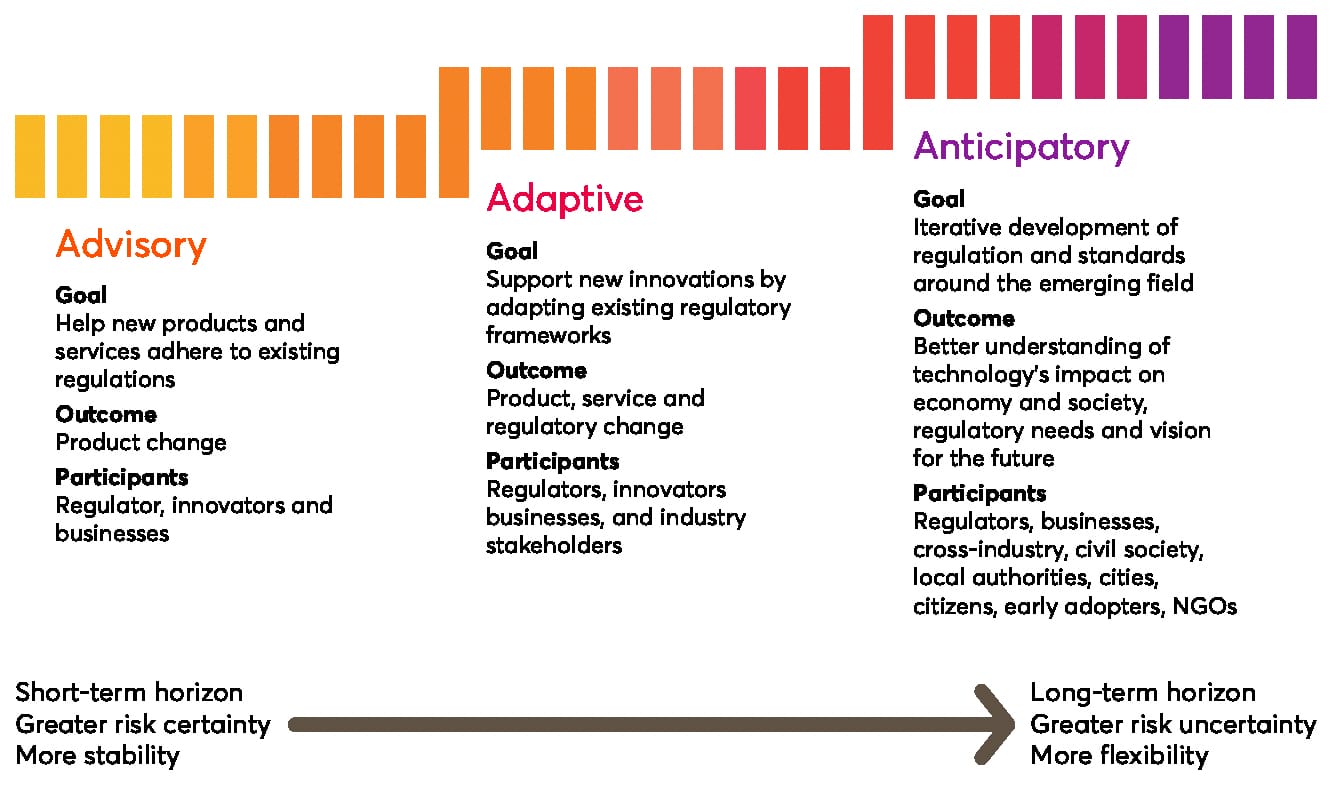
Sandbox design also varies. Three broad approaches are commonly discussed: advisory, adaptive and anticipatory.
Advisory sandboxes help innovators navigate existing rules. The law itself remains unchanged; what shifts is the guidance and supervisory posture. This is the least disruptive model and can be useful where the regulatory framework is broadly fit for purpose but poorly understood.
Adaptive sandboxes go a step further. They allow products or services to be tested in a restricted environment, with the expectation that both the innovation and the rules may change as a result. In this model, regulation and innovation evolve together. The process can be demanding to manage, but it may yield more proportionate and better‑targeted rules.
Anticipatory sandboxes, the most ambitious type, seek to understand the potential impact of emerging technologies before they are widely deployed. They are typically collaborative, involving regulators, industry, academics and civil‑society groups. They rely on continuous feedback and a willingness to revisit assumptions. In domains such as artificial intelligence or crypto‑assets, where risks and opportunities are uncertain and politically sensitive, this kind of structured foresight remains relatively rare but can be important.
The NESTA AAA model of anticipatory regulation provides a useful framework for this third type.
In inclusive finance, thematic sandboxes have been used to promote innovation that serves low‑income and excluded groups. When they are carefully designed, they can accelerate learning about which products expand access and which mainly add complexity.
Armando Guio from the Economic Commission for Latin America and the Caribbean says regulatory sandboxes are “not an invitation to bypass the rule of law, but rather an opportunity to extend beyond it to understand the impact of regulatory application on innovative ecosystems”. He argues for a deepening of a culture of regulatory experimentation. This culture must be evident in demonstrating that the aim is not to relax or soften supervisory capacities but to ensure that regulation adapts to the new changes that are taking place.
Lessons in design and management
If sandboxes are to contribute meaningfully to business environment reform, their design and management matter as much as their branding. They are best established and run by the competent regulator, rather than outsourced. Objectives should be explicit: what kind of innovation is being targeted, what risks can reasonably be taken on, and what outcomes would justify regulatory change.
Entry criteria, testing parameters and the scope of regulatory relief need to be clear to participants and to the public. So do safeguards for consumers and for the wider financial or real‑economy system. Regular dialogue with current and prospective participants is important, as it is often the main channel through which regulators learn from the sandbox.
Flexibility is another requirement. Sandbox frameworks need to be capable of adjustment as products, technologies and risks evolve. That may mean dis‑applying or modifying a wide set of requirements for a subset of firms, provided core protections remain in place. It also means having a credible exit strategy. Successful experiments may call for new licences, new rules or even new legislation. Unsuccessful ones should end in a way that does not create moral hazard or unrealistic expectations.
Sandboxes should also not be constrained by overly narrow definitions of who is, or is not, a regulated entity. Part of their value lies in catching activities that fall between existing categories and may otherwise be overlooked.
A sandbox is not a regulatory shortcut. It is a way of making the process of “testing and learning” more structured, transparent and, ideally, easier to explain to stakeholders.
One tool in a longer reform process
Regulatory sandboxes are not a cure‑all. They have proved useful in some sectors and countries, but they are resource‑intensive to build and run, and they do not suit many routine regulatory tasks. They should not become the default response to every new technology.
Regulators and those advising them therefore need to weigh sandboxes against other options: ad hoc test‑and‑learn arrangements, targeted rule changes or broader regulatory overhauls. In many contexts, these alternatives may be simpler and less demanding. Where innovation pressures are strong and regulatory uncertainty is high, however, a well‑designed sandbox can help sharpen understanding and reduce the political risks of reform.
There is emerging evidence that sandboxes can support entrepreneurship, stimulate investment and encourage regulators to adopt more modern practices, including the use of regulatory‑technology tools. At the same time, many claims about their impact remain tentative. There are no quick wins: building a sandbox, and learning from it, takes time.
For business‑environment‑reform practitioners, a balanced view is helpful. Sandboxes are a potentially valuable, but limited, instrument. Used carefully, they can help bridge the gap between innovation and rule‑making. Used without clear objectives or follow‑through, they risk becoming another short‑lived reform fashion.